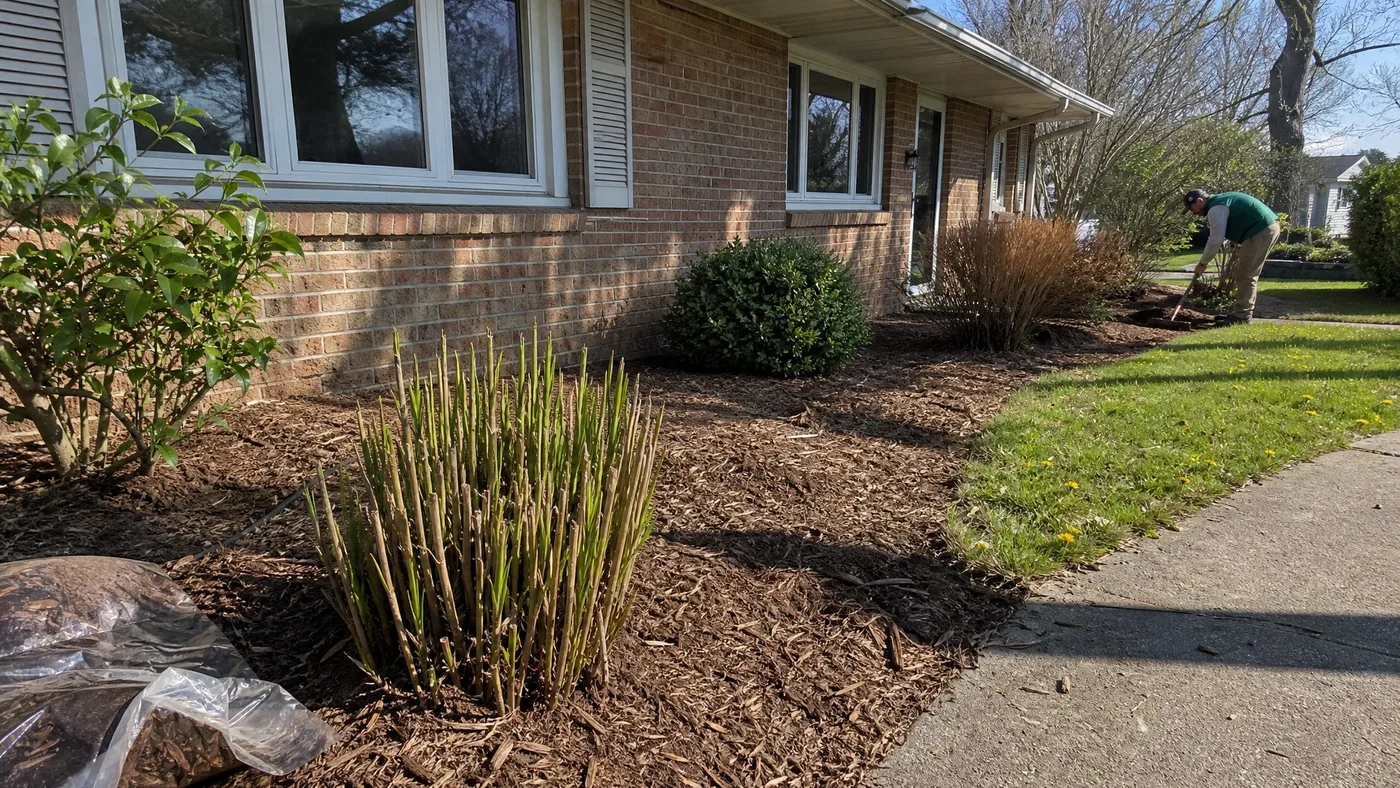
Porcupine Grass Roots: Clump Size, Depth and Removing an Old Plant
Lift a spadeful from beside an old clump and you find no taproot at all, just a tight mat of fine threads packed around a hard knot. That knot is the crown, and almost everything Porcupine Grass does above ground traces back to it: why the clump stays upright, why it never wanders into the lawn, and why a ten-year-old plant fights back when you try to move it.
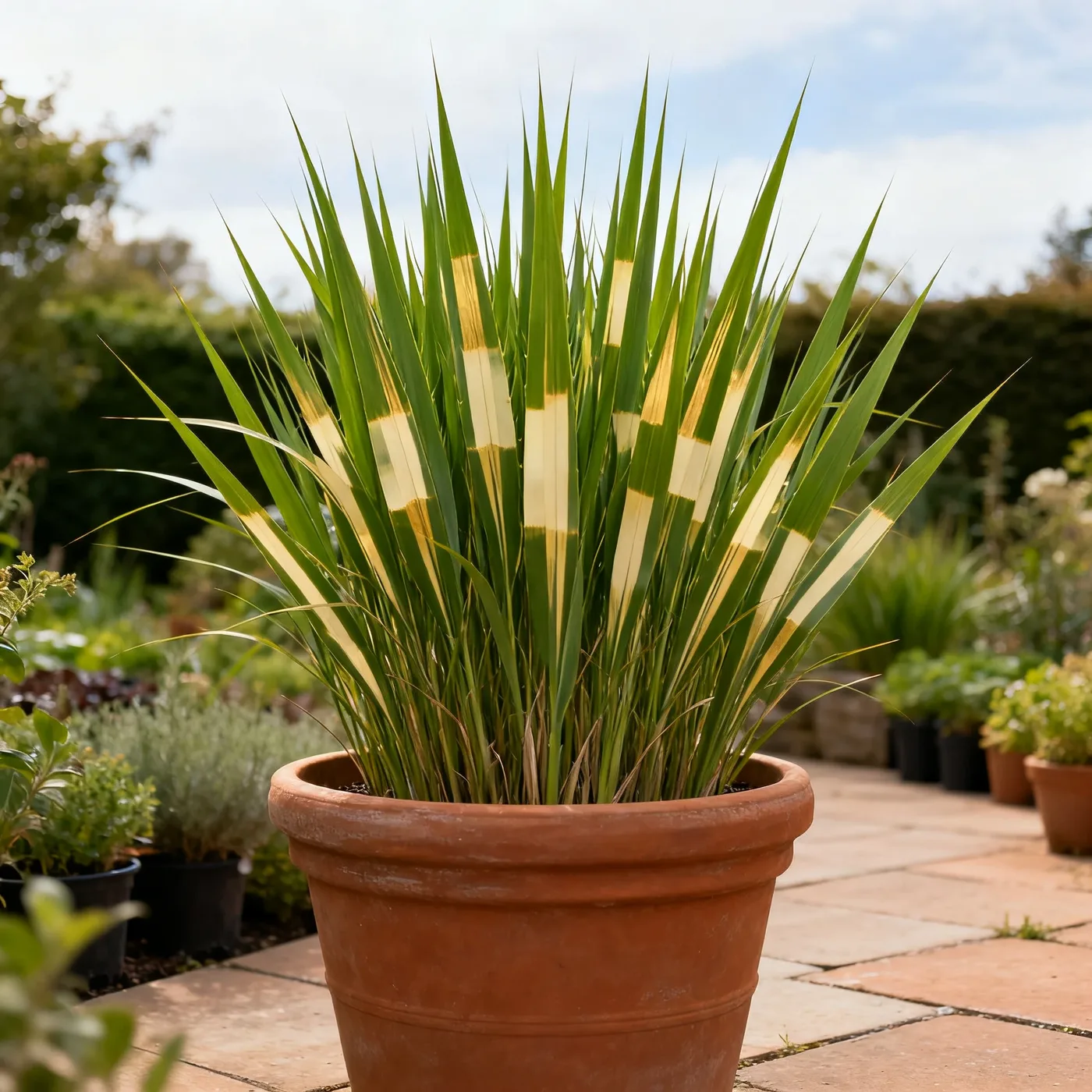
Below, you'll find out all about how the root system of Porcupine Grass is built, including how deep and wide it reaches, what that means beside paths, pipes and foundations, and how to dig out or shrink an old clump. Get the biology straight first and the work gets easier. Guess at it and you end up with a bent spade and half a plant left in the ground.
Inside a Porcupine Grass Crown
Cut an old clump in half and the cross-section looks more like a bundle of rope than a root ball. Thin fibrous roots radiate from a dense, hard core where the stems, buds and roots all meet. That core is the crown, and it holds the plant together.
Each year the crown adds new buds around its edge. Those buds send up the next season's stems, and the old stems die back to stubble that stays attached. Over time the stubble and the rhizomes (short underground stems that carry the buds) pack into one solid mass. A young plant digs out like any perennial. After roughly a decade, the clump has become woody, and a spade alone will not go through it.
Extension horticulturists at NC State say the same of the species: a large rhizomatous root mass means that, once established, it is difficult to remove. Customers usually ask us whether the roots are "like a tree." They are not. There is no single anchor root to follow down, only a dense mat to cut through.
Short Rhizomes Explain the Tight Clump
Look at an old stand of Porcupine Grass and you will see the ring of new shoots sits right against last year's. That is the signature of short rhizomes. The buds on them turn upward almost as soon as they form, so each year's growth lands next to the last instead of several feet away.
Compare that with a running grass, whose rhizomes travel before they send up a shoot. Those plants jump a bed or lawn edge and show up where you did not plant them. Porcupine Grass thickens its crown by a few inches a year and stays put. That is why it works as a vertical accent in a narrow bed, and why its size is predictable. The species takes roughly 2–5 years to reach full height.
Two cautions. Roots do not travel, but seed can in some regions, and the species is listed as invasive in parts of the US, so ask your local extension service about seedlings where you live. And as a clump ages, the center can weaken. Iowa State Extension notes that maiden grass, the species, develops dead centers in its crown as it ages. A hollow middle with a ring of green is a sign the crown is crowded, not that the plant is dying.
How Deep and Wide Porcupine Grass Roots Go
Push a digging fork into the soil beside a mature clump and you will hit resistance in the top few inches, then much less below that. The mass of the root system sits shallow and spreads about as far as the clump does. Very little of it goes straight down.
The best measurements we can point to come from the species rather than this cultivar. In a grassland study, most rhizomes sat in the upper 4 inches of soil, most roots in the upper 20 inches, and a few roots reached 47 inches. Treat those numbers as a guide. Your soil, moisture and age of plant will shift them.
| What | Typical figure |
|---|---|
| Most rhizomes | Top 4 inches of soil |
| Most roots | Top 20 inches |
| Deepest roots found | 47 inches (nearly 4 feet) |
| Mature clump width | About 3 feet |
| Foliage height | About 4–6 feet |
The practical lesson is that digging goes wide, not deep. You want a shallow, broad cut around the crown, not a hole. A few thin roots will run far deeper than the shovel does, but they are not what holds the plant.
What Roots Mean Near Paths and Pipes
A clump that touches a path edge in year one will often lift or crowd it by year five. That is the crown growing outward, not a root running underground. Because the clump spreads in a tight ring, the problem is predictable and you can plan for it before you plant.
For paths and patios, use half the mature clump width as your minimum distance from the crown center to the edge. For a 3-foot clump that is 18 inches, and a little more leaves room to cut the plant back without dragging stems across the surface. Our spacing guide gives the planting side of this.
Buried lines are a different question. Fibrous roots generally follow moisture, so the risk is a pipe that already leaks or has open joints. Sound, sealed pipe is rarely the issue, but we cannot promise it. With that in mind:
- Keep the crown out of the footprint of any known drain, water or irrigation line, since the roots can reach well below the top 20 inches.
- Avoid planting directly over a septic field or a line you expect to dig up for repairs, because removing a woody clump takes real effort.
- Call your local utility locator service before any deep dig near the plant, and ask your local extension service if you are unsure what is buried.
Porcupine Grass Beside Foundations and Walls
Where we see problems at a wall, it is almost never a root pushing anything. It is a dense clump holding moisture against masonry, or irrigation that soaks the same strip of soil beside a footing every day. The roots are fine and fibrous, nothing like the woody roots of a tree.
So the logic from the paths section carries over, with drainage added. Keep the crown center at least half its mature width from the wall, and more if the wall is old, soft brick or stucco. At 4–6 feet of foliage, an upright clump with a wide gap behind it also lets air move, which helps the wall dry after rain.
Check where roof water goes. If a downspout drains into the planting bed, the grass will be fine but the footing may not be. Move the outlet away or channel it past the clump. The species tolerates a wide range of soils and drainage, so the plant itself will not complain about a well-drained strip beside a wall. Our watering guide covers how little a mature clump needs, which is the real fix for wet footings.
Digging Out an Old Porcupine Grass Plant
The most common mistake we hear about is a homeowner who loosens the soil around a ten-year-old clump, grabs the stems and pulls. The stems snap, the crown stays put, and the next weekend the plant has resprouted. What we tell customers is to treat it as a sawing job, not a pulling one.
Tools and Prep
Clemson Extension notes that ornamental grasses with tough roots may have to be divided with a shovel, saw, or ax. Bring a sharp flat spade, a digging fork, a pry bar for leverage, a pruning saw or hand axe, gloves and a tarp. Water the clump the day before so the soil is moist but not soggy. Time the job with your normal cutback.
Step by Step
Work from the outside in. Cutting a woody clump into sections is far easier than lifting it whole.
- Cut the foliage back hard. Colorado State recommends cutting the foliage back to 4–6 inches before dividing.
- Slice a circle with the spade just outside the crown, going straight down and cutting the rope-like roots as you go.
- Saw or chop the crown into wedges, like a pie, each small enough for you to lift.
- Work the pry bar under each wedge, lever it up and drag it onto the tarp.
- Sift the hole with the fork and pull out any leftover chunks of rhizome. Pieces with a bud on them can resprout.
- Refill, firm the soil and watch the spot for a season.
Reducing a Clump Instead of Removing It
Sometimes the plant is not the problem, just the half of it that has crept toward a path. Cut a wedge out of the offending side with the saw, lift it, and leave the rest of the clump in place. A few weeks later you will see new shoots pushing up along the cut.
That regrowth is the same short-rhizome habit, working in your favor. Buds sit all along the rhizomes, and the cut face releases them. The remaining crown fills the gap, still compact, still in a ring. If the center has died out, as old clumps tend to, take that out as well and the ring of living crown often recovers.
Keep the cuts clean and the wedge sizes generous. You do not need a surgical wound, just a clear face with healthy crown behind it. Only replant a small piece. As Kansas State Extension advises, plant back a division of four or five inches in diameter, and our dividing guide walks through the propagation side.
If the old clump is beyond saving, a young plant is far easier to place. We grow Porcupine in containers, and our container size guide shows what to look for.
Why the Roots Run the Show
Every instruction above comes from one fact: Porcupine Grass builds a dense fibrous crown on short rhizomes. Because the rhizomes are short, the clump grows in a tight ring and does not run, so you can plant it a measured distance from a path or wall and trust it to stay. Because the roots are shallow and fibrous, digging is a wide, sawing job, and a gap behind the plant matters more than depth.
Because the crown turns woody with age, an old clump needs an axe or saw, and cutting out a section works because the buds on the remaining rhizomes release growth at the cut. A compact crown means you plan the digging, not the spreading.
Porcupine Grass
Nursery-grown Porcupine Grass in sizes from Quart, shipped to your door.
From $19.99
Shop Now →Our Porcupine clumps stand in full sun, in rich, moist soil, and every late winter we cut them back so the fresh growth comes in clean. We are a small team of growers who work our own farms, and we dig, pot and ship top-quality grasses ourselves. If this guide has you ready to replace a stubborn old crown with a young one, pick out a Porcupine Grass for your garden.