Porcupine Grass vs Giant Miscanthus: Why Size Matters at Purchase
Last August a visitor stood at the end of our rows, tipped her head back at a ten-foot stand of something enormous, and asked why the Porcupine Grass she'd ordered online looked so much smaller on our tags.
The answer was simple. She was looking at giant miscanthus, a different plant, and the shorter tag belonged to the right one. The mix-up is common because Porcupine Grass is among the tallest ornamental Miscanthus sinensis cultivars, and sellers use the nickname elephant grass loosely for both.
This guide covers everything you need to know about telling these two grasses apart, from how tall each really stands and how each holds its clump to what it takes to cut or remove one and which listing details to check before you order. Get it wrong and you end up with a screen that never screens, or a thicket you never planned for.
Standing Beside Our Rows of Giant Miscanthus
Walk into a stand of giant miscanthus in late summer and the first thing you notice is the sound. Hundreds of tall stems brush together overhead with a dry, constant rustle, and the light goes green and dim at eye level. You look up for the tops and have to tip your head back. At 10 to 14 feet, they sit well above the rim of a basketball hoop.
Pushing through takes effort. The stems stand close and stiff, so the stand reads as a wall rather than a plant. That is what it is made for. Giant miscanthus (Miscanthus x giganteus) is a field crop, and a field crop wants to be dense, tall and uniform.
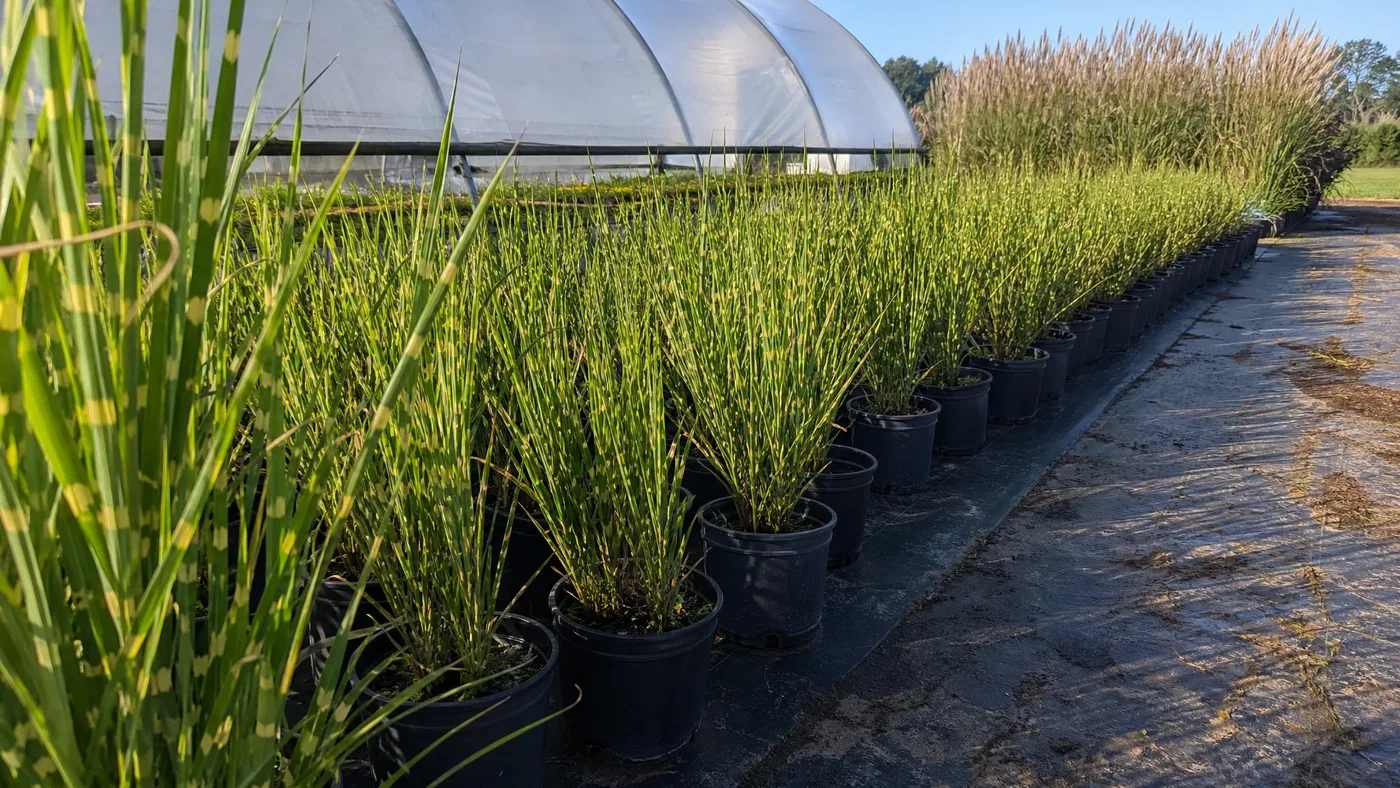
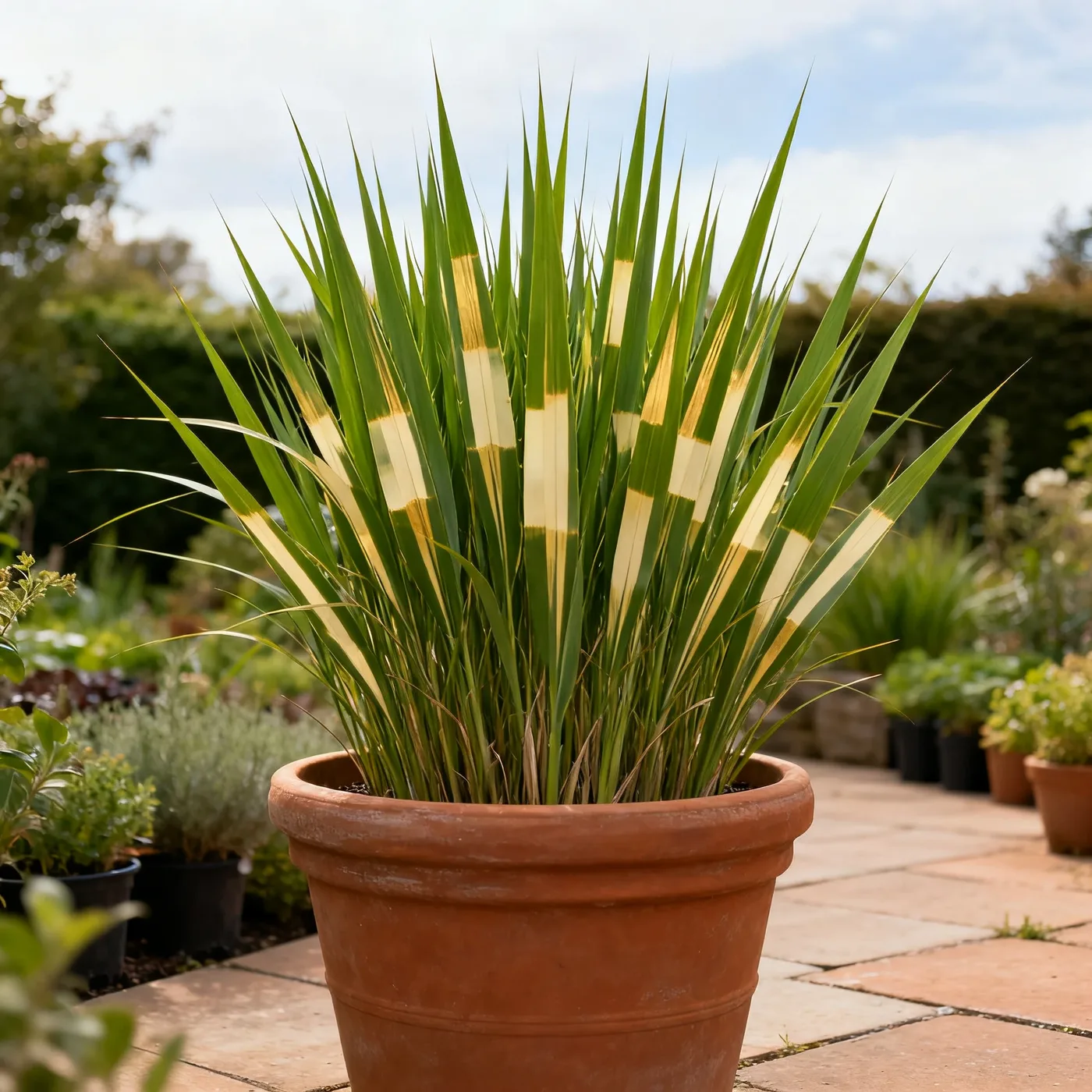
Now step over to Porcupine Grass. It rises in a narrow, upright vase, and you can see across the bed. The blades carry bright yellow, horizontal variegation that looks like the bands on a porcupine quill. In late summer rosy-plum plumes lift above the foliage and slowly turn silver.
Run a hand along the blades and you feel the difference too. Porcupine has the fine, sharp-edged texture of an ornamental, with the plumes moving in the slightest air. The giant feels like standing inside a hedge of canes.
From across the field you can tell the two apart before you read a single tag. One is a wall. The other is a specimen.
Where Porcupine Grass Stops Short of Elephant Grass
Here is the sizing lesson we repeat most. Porcupine Grass is tall for an ornamental, and the numbers you see online differ because sources measure different things. Some give the foliage mound alone, others count the plumes. Neither is wrong, but neither is a 12-foot plant.
| Plant | Typical height | What that number includes |
|---|---|---|
| Porcupine Grass, foliage | 4–5 feet | The banded mound before plumes rise |
| Porcupine Grass, in flower | 6–8 feet, up to 9 | Upright plumes above the foliage |
| Most other M. sinensis cultivars | 3–6 feet | Whole plant, varies by cultivar |
| Giant miscanthus | 10–14 feet | Mature canes in an established stand |
Foliage Versus Plume Height
Missouri's extension figures put a mature Porcupine clump at about 48 to 60 inches of foliage. Florida's extension lists it at 6 to 8 feet tall once plumes are up, and Illinois extension says it reaches nine feet in flower.
Plan for the plumes, because they are the part you will look at. Our size and growth rate guide walks through how it gets there.
Why It Looks Taller Than Its Cousins
Most M. sinensis cultivars top out around 3 to 6 feet, so Porcupine stands out in a row of its relatives. It also grows more upright than zebra grass, according to the University of Georgia, which keeps the height narrow and tall rather than arching. That vertical habit is why it reads bigger than the numbers suggest, and why it gets mistaken for something bigger still.
What the Gap Means for Your Plan
If you need a 10-foot privacy screen, Porcupine will not give you one, whatever a listing implies. What we tell customers is that it makes a superb 6 to 8 foot vertical accent, and a good one for tight spots. Calling it a screening grass stretches the truth a little. For a true screen you need a different plant, or several Porcupines planted close together to make a loose, seasonal hedge.
Porcupine Grass Clump Habit, Watched Season After Season
Porcupine Grass is a clump-forming grass, and it behaves like one. Each spring the crown sends up a slightly wider ring of shoots than the year before, and that is about all the drama you get. Growth is medium, and it can take 2 to 5 years to reach full height. After that the clump simply gets a little heavier at the base.
A garden listing puts it near 3 feet wide, while the species as a whole can run 4 to 6 feet. We plan a little extra room for the species figure and rarely need it.
Giant miscanthus is a different story. It is planted from rhizomes, and a stand fills outward and thickens as those underground stems run. A planting made to be a crop does not stay where you put it.
Room for the Ornamental
Give Porcupine a spot where the clump can swell to its width and the plumes can stand without crowding a path. Plant it in full sun, where it holds its upright form best. Our spacing guide covers distances for borders and mass plantings.
Leave it alone after planting and it will stay in its lane for many years. It adapts to most soils, so the main job is giving it sun.
Room for the Giant
If you decide you do want giant miscanthus, think in terms of a field edge, a large acreage or a windbreak, not a bed. The footprint grows with every season, and edging it is a recurring job. Do not put it next to a neighbor's fence or your lawn unless you want to meet it again every year.
Our roots and clump guide shows what a Porcupine clump looks like below ground for comparison.
Why Porcupine Grass Rarely Needs a Chainsaw
Cutting is where the two plants part ways most clearly. A Porcupine clump is a once-a-year job with ordinary tools, and you can finish it in an afternoon. The plumes persist into winter, so leave the clump standing through the cold months and cut it once the worst of winter is behind you.
Giant miscanthus canes are thick, woody and densely packed. Plan on heavy tools such as a brush cutter or even a power saw for an established stand. Nothing about it is delicate, and the cut material is bulky enough that you will want somewhere to put it.
Cutting Back Porcupine Grass
Wear long sleeves and gloves, because the blade edges are sharp. Then follow these steps, and see our winter care guide for timing in your zone.
- Wait until late winter, before new green shoots show at the base.
- Gather the stems into a bundle and tie it with twine so nothing scatters.
- Cut the bundle with hedge shears or loppers, leaving a few inches above the crown.
- Lift the bundle away and compost it, then leave the clump to push fresh growth.
That is the whole routine. No pruning schedule, no thinning, no fuss.
Clearing a Plant You No Longer Want
Digging out a single Porcupine clump is hard work but finite. You cut it down, loosen the soil around the crown with a spade or fork, and lever the whole mass out. A giant miscanthus stand is a project of its own, with rhizomes spread through the soil that can resprout, so take that into account before you plant it near anything you care about.
Sterile Biomass Hybrid, Ornamental Porcupine Grass
The two plants are related, which is part of the confusion. Penn State describes giant miscanthus as a sterile hybrid of Miscanthus sinensis and Miscanthus sacchariflorus, the species most commonly used for bioenergy. Extension trials show it reaching up to 12 feet and producing an average of up to 8 to 12 tons per acre a year. It is a working plant, grown for volume.
It is also planted from rhizomes, which makes it more expensive to establish than crops grown from seed. All of that points to a farm, not a flower bed.
What You Get With Porcupine Grass
Porcupine Grass is a garden cultivar of the sinensis side only. You buy it for yellow bands across the blades, plumes that open rosy-plum in late summer and turn silver, and a stiff upright shape that stays good into winter. It is hardy in zones 5 to 9 and wants full sun.
The plumes also give you something to look at long after the flowers fade, since the silky tassels of Miscanthus persist into winter. That winter silhouette is something a biomass crop is not planted for.
A Note on Seeding
One honest note. Sterility belongs to the hybrid, not to Porcupine. Clemson's extension calls the species a non-native, invasive grass in the landscape trade, while other extension sources describe typical cultivars as clump growers. Check with your local extension service about reseeding in your region before planting.
Reading Tags and Listings Before You Order
One of the most common questions we get is whether the grass in a photo is the one that will show up in the box. Mislabeled orders usually come down to a nickname and a vague height claim, so read the listing closely before you pay.
- Look for the full botanical name, Miscanthus sinensis 'Strictus'. If you see Miscanthus x giganteus instead, you are buying the biomass hybrid.
- Treat "elephant grass" as a warning, not a name. Sellers use it loosely, so ask which plant is meant.
- Check what the height claim measures. A 6 to 8 foot figure should include plumes, and the listing should say so.
- Look at the photo for horizontal yellow bands. If the leaves are plain, ask why.
- Compare pot size and what is actually shipped, a rooted potted clump or a bare rhizome piece.
Pot Size and Height Claims
A small pot never shows the mature height, so a listing that promises 10 feet from a young plant is describing the wrong thing. Porcupine takes 2 to 5 years to reach its full height, and the size in the pot tells you only what you are starting with. For container sizes and what to expect from each, read our buying guide.
If a seller cannot answer these questions plainly, that tells you what you need to know.
Choosing the Right Porcupine Grass for Your Border
Here is where we land. For nearly every garden, we would choose Porcupine Grass. It reaches a generous 6 to 8 feet, holds a tidy clump, goes down with hand tools and gives you banded blades and plumes you will want to look at. Choose giant miscanthus only if you have real acreage and a real need for 10 to 14 feet of dense cover.
Picture those rosy-plum plumes swaying at your own fence, right-sized and well mannered. And if a listing says elephant grass, ask us before you buy it.
Porcupine Grass
Nursery-grown Porcupine Grass in sizes from Quart, shipped to your door.
From $19.99
Shop Now →Our Porcupine Grass is raised on our farms in full sun, and that steady light is what builds the tidy, banded clump this guide recommends. Every plant we sell is one that our small crew of growers has raised from start to finish, so you can trust what you receive. If the right-sized grass for your border is the one you pictured, begin with a Porcupine Grass from us.